
Aaron Rodgers, one of football’s most enigmatic and talented quarterbacks, is embarking on what could be his final NFL season.
The 42-year-old signed a one-year deal with the Pittsburgh Steelers following his release by the New York Jets after the 2024 season.
This “Goodbye Tour” has everyone asking: is this the beginning of the end for one of the greatest to ever play the position, or the perfect setup for one last championship run? Standing 6-2 and weighing 223 pounds, Rodgers’ physical presence belies his cerebral mastery of the game.
His journey from backing up Brett Favre for three years to becoming the Packers’ starting quarterback in 2008 showcases his patience and eventual dominance. At this stage of his career, every decision carries weight, every throw might matter, and every game could define his legacy.
Rodgers’ move to Pittsburgh represents far more than a typical veteran signing—it’s a calculated final chapter in one of sports’ most compelling narratives.
Aaron Rodgers is entering what may be the final chapter of an NFL career that spans more than two decades.
The 42-year-old signed a one-year deal with the Pittsburgh Steelers, the team announced, after the New York Jets released him following the 2024 season — a move that immediately reframed the conversation around his legacy. Standing 6-foot-2 and 223 pounds, Rodgers has never been defined by raw athleticism alone.
His dominance has always been cerebral: pre-snap reads, pocket manipulation, and an almost surgical command of the passing game that few quarterbacks in league history have matched.
He spent three seasons backing up Brett Favre in Green Bay before taking over as the Packers’ starter in 2008, and the patience that defined that waiting period has characterized his entire approach to the game.
Now, in Pittsburgh, every snap carries a different kind of weight. This isn’t just a veteran looking for one more paycheck — it’s one of the most decorated quarterbacks in NFL history making a calculated bet that he has enough left to chase a second Super Bowl ring.
The Mysterious Hand and the Calm Before the Storm
The résumé Rodgers carries into Pittsburgh is almost impossible to overstate. Four AP MVP awards, as verified by the Steelers, four PFWA MVP honors, ten Pro Bowl selections, and four All-Pro designations place him in the most exclusive tier of NFL history.
He won Super Bowl XLV following the 2010 season, earning MVP honors in that game, as the Steelers noted, and was named AP Athlete of the Year in 2011.
His career Approximate Value of 169 ranks third among all players since 1960, per Pro Football Reference.
But the number that most clearly separates Rodgers from his peers is his 1.4% career interception rate — the lowest in NFL history — a figure that reflects not just arm talent but an elite level of decision-making under pressure across nearly two decades of starts.
His 102.6 career passer rating ranks first all-time in the regular season, and he holds the best touchdown-to-interception ratio in league history at 4.34.
These aren’t just impressive numbers — they represent a standard of ball security and efficiency that no quarterback has ever sustained at this volume.
The path from Green Bay to New York to Pittsburgh has been anything but conventional, but the production has remained consistent enough to keep the legacy conversation very much alive.
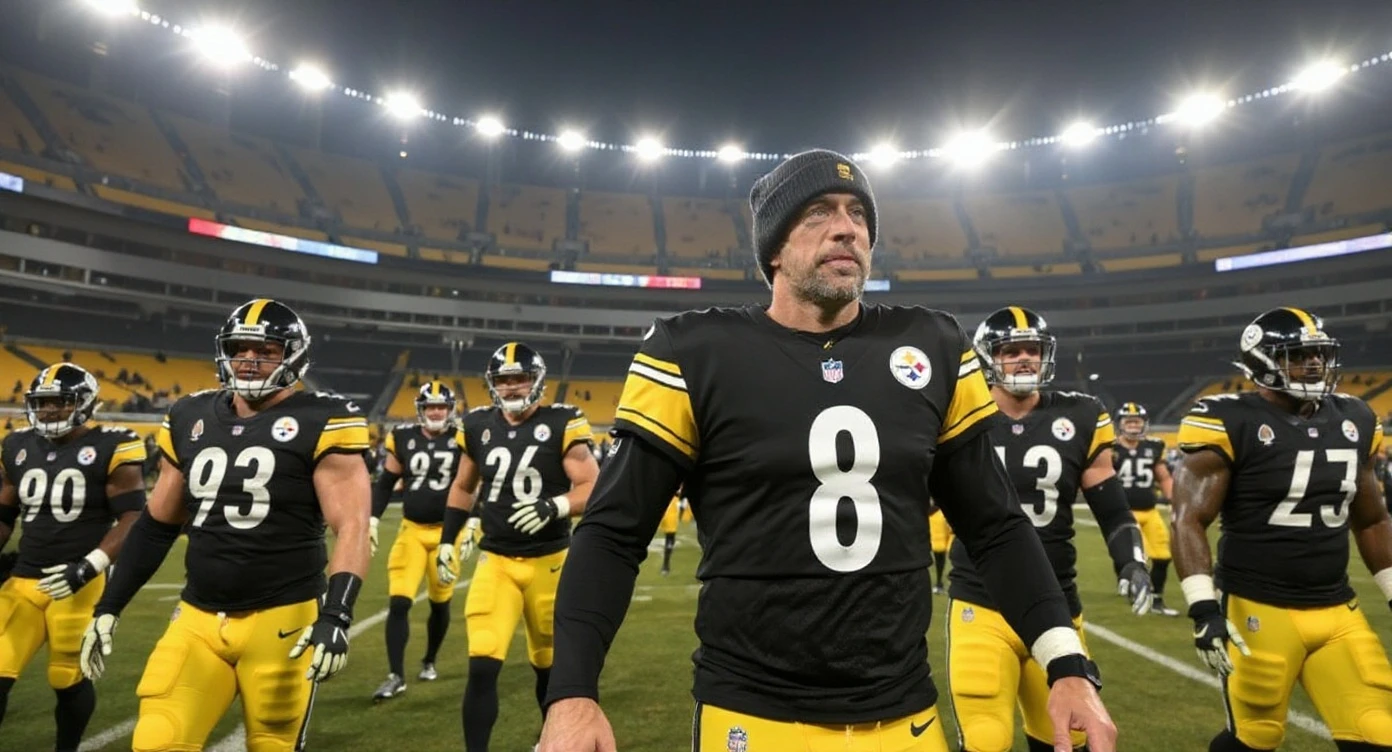
Can a 20-Year Veteran Still Be a Game-Changer? The Steelers’ Calculated Gamble
Statistics tell part of the story, but Rodgers’ reputation was built on moments that numbers struggle to capture.
His composure in late-game situations has been a defining trait throughout his career — the kind of calm that separates quarterbacks who perform in big moments from those who simply survive them.
Scouts and analysts have long pointed to his field vision as exceptional even by elite NFL standards: the ability to process multiple coverage looks simultaneously, manipulate defenders with his eyes, and find windows that close in fractions of a second.
His path to Green Bay ran through Butte Junior College and then the University of California, and even then, evaluators flagged his football IQ as a differentiating factor.
The real question entering 2025 was whether those instincts remained sharp after two years of organizational dysfunction in New York.
The answer, at least statistically, was yes. Rodgers posted 3,322 passing yards, 24 touchdowns, and just 7 interceptions across 16 games in his first season with Pittsburgh — a 3.43 touchdown-to-interception ratio that tracks almost exactly with his career standard.
The precision that defined his peak years in Green Bay showed up again in a Steelers uniform, and that continuity matters enormously when evaluating what he can still deliver in January.